
By Alex Reed, Senior Gaming Contributor
Understanding classic solitaire rules is the easiest part of Klondike—the real challenge is learning how to uncover hidden cards without trapping yourself into a dead end.
Few games have quietly racked up as many hours as Solitaire. For a whole generation, it was the first video game they ever played, tucked inside a work computer and opened “just for a minute.” Today it lives on in browser tabs, phone apps, and daily challenge modes, and it’s as popular as ever.
Why does it endure? Because it’s calm, it’s quick, and it feels like a puzzle you should be able to solve. And that’s where the frustration creeps in. Most lost games of Solitaire aren’t lost at the end. They’re lost early, when a careless move buries the one card you’ll desperately need later.
The heart of winning Solitaire is simple: uncover the hidden cards as fast and as safely as you can. This guide shows you how.
Core Mechanics: Classic Solitaire Rules and Layout
The version most people know is Klondike, so that’s what we’ll focus on.
The Layout
- The Tableau: Seven columns of cards. The first column has one card, the second has two, and so on up to seven. Only the top card of each column starts face up.
- The Foundations: Four empty piles at the top, one for each suit.
- The Stock: The leftover cards, face down, which you draw from.
- The Waste: Where drawn cards land, face up.
The Rules
- Build foundations up by suit, from Ace to King (A, 2, 3… through K of hearts, for example).
- Build tableau columns down in alternating colors. A red 7 can go on a black 8, a black 6 on a red 7, and so on.
- You can move stacks of correctly ordered cards between columns as a group.
- When you move the face-up cards off a hidden card, flip it over. That’s how you reveal the deck.
- Only a King (or a stack starting with a King) can fill an empty column.
- Draw from the stock when you’re out of moves. You’ll either draw one card at a time (Draw 1) or three at a time, with only the top one playable (Draw 3).
You win when all 52 cards are on the foundations.
The Real Goal
Here’s the mindset shift that changes everything: the foundations are the finish line, but the face-down cards are the actual challenge. There are 21 hidden cards in the tableau at the start, and every one you flip gives you new information and new options.
Proven Strategies & Pro Tips
Prioritize the Biggest Hidden Piles
Not all columns are equal. The rightmost column hides six cards, while the second column hides just one.
- When you have a choice of moves, pick the one that frees a card from the tallest face-down pile.
- Short columns can wait. They’re easy to clear later.
- Keep a mental count of which columns are still deep. Those are where games get stuck.
Play From the Tableau Before the Stock
It’s tempting to flip through the stock right away. Don’t. Before drawing, scan the tableau for any move that reveals a hidden card. The stock isn’t going anywhere, but a tableau move might open up the very card that lets you use your next draw.
Don’t Rush Cards to the Foundations
This sounds backward, but it’s one of the most important tips in the game. Aces and 2s should go up immediately, since they’re never useful in the tableau. Beyond that, think before you send a card home.
- Ask: “Will I need this card to hold something lower?” A black 5 on the foundation can’t catch a red 4 you’re trying to move off a hidden card.
- Keep the foundations roughly even. If your hearts are at 8 but your clubs are at 3, you’ve probably sent some useful cards up too soon.
Common Mistakes to Avoid
- Emptying a column with no King ready. An empty space is only valuable if you can fill it with something useful.
- Moving cards just to move them. Shuffling a stack between two columns without revealing anything wastes the opportunity.
- Ignoring the waste pile’s order in Draw 3. Playing one card changes which cards you’ll see on the next pass.
- Undoing too quickly. If your app has undo, use it to learn, not just to escape.
Comparing Solitaire Game Modes
Klondike comes in a few flavors, and the one you pick dramatically changes your odds and approach.
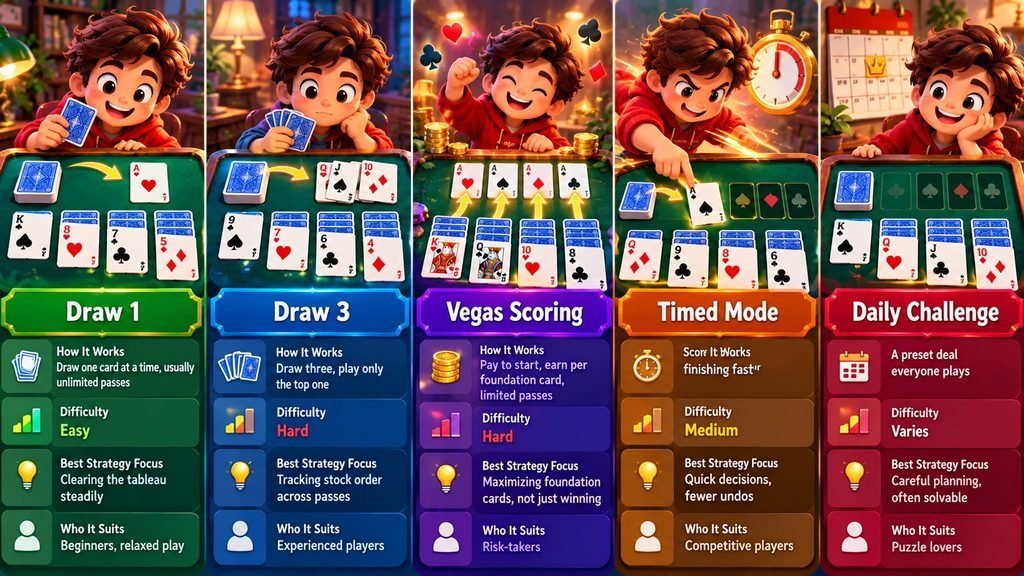
If you’re still learning, play Draw 1 until the strategies in this guide feel automatic. Then move up to Draw 3, where the real skill shows.
Advanced Tactics & Winning Secrets
Choose Your Kings Carefully
When a column empties and you have two Kings available, don’t just grab the first one. Pick the King that sets you up best. If you have a red Queen waiting, choose a black King. If one King is sitting on top of a deep hidden pile, moving it frees those cards up as well.
Plan Color Chains Ahead
Before you make a move, glance at what comes next. If you place a red 9 on a black 10, you’ll want a black 8 soon. Do you know where the black 8s are? If both are buried, that column might become a dead end.
Master the Draw 3 Cycle
In Draw 3, the stock follows a predictable order. Every time you play a card from the waste, the cards shift, and you’ll see different ones on the next pass.
- On your first pass, note which useful cards are stuck in the middle of a group.
- Play a card from the waste at the right moment to shift the order so those cards rise to the top.
- Avoid playing from the waste without purpose on a final allowed pass, since it can scramble a cycle you’d figured out.
Rearrange Stacks to Unlock Cards
Sometimes the move you need isn’t obvious. If two columns both end in a red 6, for example, you might move a stack from one to another just to free up a black 7 for a different job. These “swap” moves are what separate winners from players who declare a game hopeless too early.
Know When a Game Is Lost
Not every deal can be won. Even expert players lose some Klondike games, especially in Draw 3. If you’ve cycled the stock with no new moves and every hidden card is blocked, accept it, learn from it, and deal again. Spotting a lost cause quickly saves you time for winnable games.
Use Undo as a Teacher
If your app allows unlimited undo, try replaying a lost game from a key decision point. Testing the other branch is one of the fastest ways to build instinct for which moves pay off.
Final Verdict: Who Will Love This Game?
Classic Solitaire is perfect for players who want a calm, thoughtful break without the pressure of opponents or timers. It’s great for puzzle fans who enjoy planning a few moves ahead, and it’s an easy fit for casual web gamers who want something quick to dip into between tasks.
If you crave nonstop action or competition against real people, Solitaire might feel too quiet. But if you enjoy the satisfaction of turning a messy layout into four neat piles, few games deliver that feeling better.
Remember the core lessons: target the deepest hidden piles, play the tableau before the stock, hold back on the foundations, and choose your Kings wisely. Get those habits down, and you’ll find yourself stuck far less often and watching that victory card cascade far more.
Now go shuffle up a new deal. That stack of hidden cards isn’t going to flip itself.