
By Alex Reed, Senior Gaming Contributor
Some games come and go. Bubble Shooter has been around for decades. It started in arcades with titles like Puzzle Bobble (also known as Bust-a-Move), and today it’s one of the most-played genres on browsers and phones. The appeal is easy to see. You learn it in five seconds, a round fits into a coffee break, and there’s real satisfaction in watching half the board fall away from one well-placed shot.
Behind the bright colors there’s real strategy. The best players don’t just match colors. They read the board, bank shots off the walls, and set up big drops that clear dozens of bubbles at once. This guide covers how they do it.
Core Mechanics & How It Works
The Basic Gameplay Loop
Every Bubble Shooter follows roughly the same pattern:
- A cluster of colored bubbles hangs from the top of the screen.
- You aim a launcher at the bottom and fire one bubble at a time.
- When your bubble touches three or more bubbles of the same color (including itself), the group pops.
- Any bubbles left without a connection to the ceiling drop off the board, usually for bonus points.
- If the bubbles reach the bottom line, the game is over.
Controls
On browser versions, you aim with the mouse and click to shoot. On mobile, you drag your finger to aim and release to fire. Many versions show a dotted aiming line that helps with bank shots. Most also show your next bubble in a preview slot, and some let you swap your current bubble with the next one, often by clicking the launcher or tapping the preview.
The Rules That Matter Most
- The grid is staggered. Bubbles sit in offset rows like a honeycomb, so each one touches up to six neighbors. Your shot settles into the nearest open slot, which is not always exactly where you aimed.
- Walls bounce. Shots reflect off the side walls cleanly, and this is your most powerful tool.
- Misses add pressure. In many versions, a set number of shots that don’t pop anything will push the whole ceiling down a row or add a new row of bubbles.
- Colors only come from the board. Most games only give you colors that are still on screen, so clearing a color completely makes later shots easier to predict.
Proven Strategies & Pro Tips
How to “Calculate” Angles Without Any Math
The title says “calculate,” but you don’t need a protractor. The idea is to use the wall as a mirror.
- Find your target bubble.
- Picture a copy of that target reflected on the other side of the wall you plan to bounce off.
- Aim straight at that imaginary copy. The point where your aim line meets the wall is your bounce point.
- A quick rule of thumb: if your target is high up the board, the bounce point sits roughly halfway up between your launcher and the target’s height. Lower targets need lower bounce points.
After a few dozen bank shots, this becomes muscle memory. If your game shows an aiming guide, use it to check your instinct. Over time you’ll stop needing it.
Pro Tips for Everyday Play
- Aim high, not wide. Pops near the top of the cluster are the ones that cause drops. Clearing bottom bubbles only buys you breathing room.
- Check the next bubble before every shot. Plan two moves at once. If the next bubble is red, don’t block the only red cluster with your current shot.
- Use swap wisely. If your current bubble has no good spot, swap it. Don’t waste a shot or bury a useful color.
- Don’t stack “junk” in one place. When you’re forced to make a bad shot, put it on the edge of the board, not in the middle where it blocks paths.
- Watch the miss counter. If the ceiling is about to drop, a safe, small pop is better than a risky big setup.
- Keep bank lanes open. Avoid filling the bubbles nearest the walls too early. Those gaps are your highways to hard-to-reach spots.
Common Mistakes to Avoid
- Firing too quickly and letting the game choose the slot for you.
- Chasing every three-bubble match instead of looking for drops.
- Ignoring a color that’s almost gone. Removing the last few bubbles of one color narrows down what you’ll be dealt next.
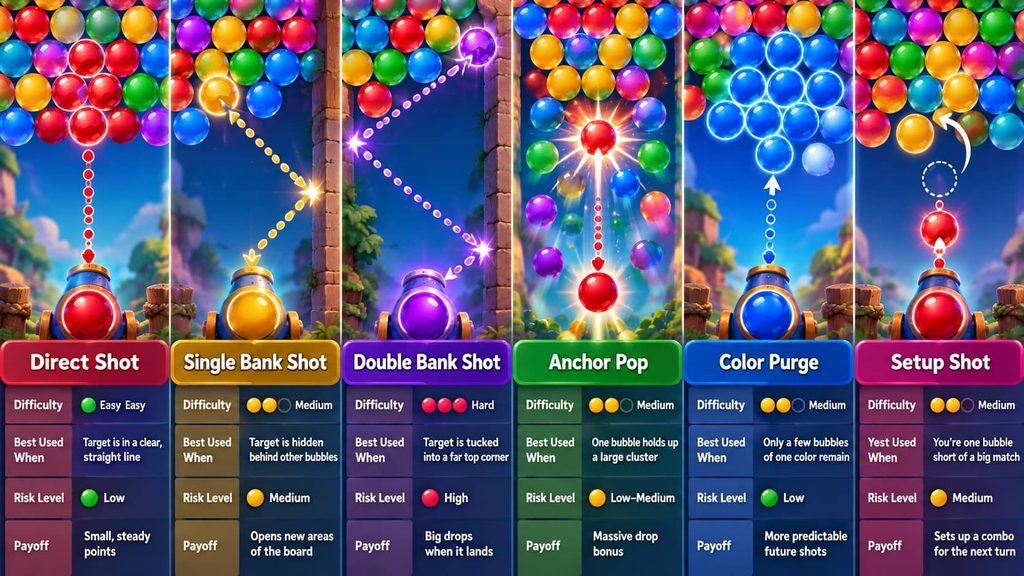
Comparison Table: Shot Types and Strategies
Advanced Tactics & High-Score Secrets
Find the Anchor
The key to massive drops is the anchor: a small group of bubbles holding up a large section of the board. Look for narrow “necks” where a big cluster connects to the ceiling through only one or two bubbles. Pop that neck, and everything below it falls.
- Scan the board from the top down, not the bottom up.
- Look for the thinnest connection between a big group and the ceiling.
- Check the color of that connection and keep an eye out for a matching bubble.
- Use a bank shot if the anchor is blocked from straight-on angles.
In most versions, dropped bubbles are worth more than popped ones, so one anchor shot can beat ten ordinary matches.
Build Setups on Purpose
Strong players don’t just react. They build. If two blue bubbles sit next to an anchor, add one more blue nearby on a quiet turn so that the next blue you get triggers the drop. It’s like setting up a chain in a match-three game: a little patience now pays off later.
Use Bubbles as Bumpers
Sometimes you can’t reach a slot directly. A bubble can also “stick” against the side of another bubble, so you can deliberately graze an existing bubble to settle into a gap next to it. This takes practice but opens up placements most players think are impossible.
Manage the Ceiling Clock
In versions where the ceiling drops after missed shots, plan around the countdown. Spend your “free” misses on setup shots, then pop something just before the counter runs out. That way, pressure only arrives on your terms.
Clear the Top Corners Early
Top corners are the hardest places to reach and are often the last bubbles left on the board. Deal with them while you still have open bank lanes, before the middle of the board fills in.
Final Verdict: Who Will Love This Game
Bubble Shooter is one of the best “easy to learn, hard to master” games around. Casual players will love it as a relaxing, colorful way to unwind with almost no learning curve. Puzzle fans will enjoy the planning side, reading the board, spotting anchors, and setting up chain reactions. Score chasers will find plenty of depth in perfecting bank shots and building drop combos.
If you take away just three things from this guide, make them these: aim for the top, use the walls as mirrors, and always look for the anchor. Master those, and you’ll go from popping bubbles to bringing down the whole board.