
By Alex Reed, Senior Gaming Contributor
Playing Mahjong Solitaire for beginners often starts as a calm, peaceful experience—until twenty minutes in, you are left with eight tiles, zero legal moves, and a completely blocked boardMahjong Solit.. A neat pyramid of decorated tiles, soft music, no timer breathing down your neck. Then, twenty minutes in, you’re left with eight tiles and not a single legal match. Board blocked. Shuffle or start over?
That moment is the whole story of the game. Mahjong Solitaire (sometimes called Shanghai or Mahjong Connect in its flat variants) has been a browser and desktop staple for decades because it’s easy to learn and endlessly replayable. But beneath the relaxing surface sits a genuine puzzle: every match you make changes what’s possible later.
The good news? Getting stuck is almost always the result of a few avoidable habits. This guide will teach you how to read the board, spot blocked tiles before they trap you, and plan your way to a clean finish.
Core Mechanics: Mahjong Solitaire for Beginners
The Goal
Remove every tile from the board by matching identical pairs. That’s it. Despite the name, this game has nothing in common with traditional four-player Mahjong beyond the tiles themselves.
The Tiles
A standard set has 144 tiles, usually arranged in the classic “turtle” layout. They fall into a few groups:
- Suits: Dots (circles), Bamboo (sticks), and Characters, each numbered 1 through 9.
- Winds: East, South, West, and North.
- Dragons: Red, Green, and White.
- Flowers and Seasons: Four of each, and they’re special (more on that below).
Most tiles appear four times in the set, which is a crucial detail for strategy.
What Makes a Tile “Free”
You can only select a tile if it’s free. A tile is free when:
- No tile is sitting on top of it, even partially.
- Its left or right side is open. At least one of those long sides must have no tile directly next to it.
The top and bottom edges don’t matter. A tile boxed in on both the left and right is blocked, even if nothing sits above it.
The Matching Rules
- Select two free, identical tiles to remove them.
- Any Flower matches any other Flower, and any Season matches any Season, even though the pictures differ.
- If no free pairs remain, you’re stuck. Many versions offer a shuffle or hint to help.
Proven Strategies & Pro Tips
Don’t Just Match the First Pair You See
This is the number one beginner mistake. Spotting a pair feels great, so you click it right away. But the real question is: which match opens the most new tiles?
- Before matching, scan for every available pair.
- Ask what each match uncovers. Does it free a tile below? Does it open the side of a long row?
- Pick the match that unlocks the most options. A pair that frees nothing is often best saved for later.
Work on Tall Stacks First
The central stack in most layouts is several tiles high, with one cap tile on top. Those buried tiles are the hardest to reach, so they’re the most likely to trap you late in the game.
- Clear the top of tall stacks early whenever you have a match available.
- Prioritize tiles that sit on top of other tiles over tiles lying flat on the bottom layer.
Open Up Long Rows From the Ends
The widest horizontal rows can only be cleared from the outside in. A 12-tile row means only the two end tiles are free at any time.
- Start chipping away at long rows early, so their middle tiles aren’t still locked when the board gets thin.
- The special edge tiles in the turtle layout (the ones that stick out on the left and right) block entire rows. Clearing them early is a big deal.
Common Mistakes to Avoid
common mistake when playing Mahjong Solitaire is
- Clearing the easy outer tiles first while ignoring the center stack.
- Forgetting that a tile needs only one open side. Many beginners miss perfectly playable tiles.
- Leaning on hints. They show you a match, not the best match.
- Mixing up similar tiles. Bamboo 1 often looks like a bird, and the White Dragon is sometimes just a blank or framed tile. Learn your set’s art.
Comparing Common Move Choices
When you’ve got several matches available, here’s how to judge them:
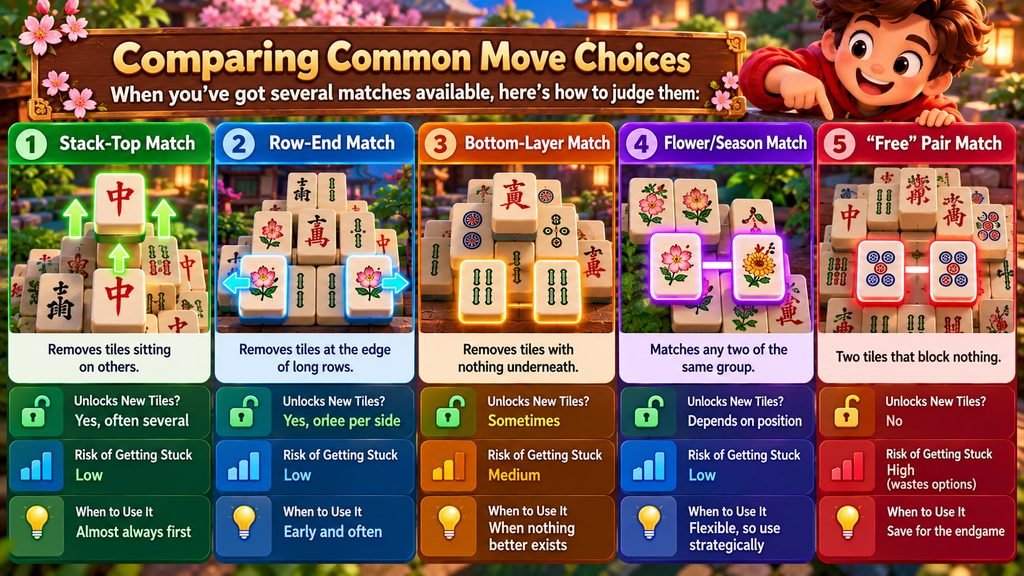
The pattern is clear: matches that reveal more tiles keep you alive longer.
Advanced Tactics & Winning Secrets
Count the Fours
Since most tiles come in sets of four, tracking them is the key to avoiding dead ends.
- If all four copies of a tile are free, match both pairs immediately. There’s zero risk.
- If three copies are free, think carefully. Match the two that unlock the most, and leave the third in a spot where its last partner will become available.
- If two copies are already gone, the remaining two must match each other. Make sure one isn’t stuck under the other.
Watch for Self-Blocking Tiles
This is the classic trap. Imagine both remaining copies of the Red Dragon are in the same stack, one directly on top of the other. The top one can never match the bottom one, because the bottom one is blocked until the top one leaves. That board is now unwinnable.
To avoid it, watch for stacks where a tile sits above one of its own copies. If you spot one, use the other copies to clear the upper tile before you run out of partners.
Save Your Flexible Tiles
Flowers and Seasons can match any member of their group, which makes them handy. Don’t burn them early just because they’re easy. Use them when they free up a critical tile.
Think One Match Ahead
Before every match, ask: “After this, what new pairs will I see?” Over time, this becomes automatic, and it’s the clearest difference between beginners and experienced players.
Use the Shuffle Wisely
If your version offers a shuffle, save it for true dead ends. And remember that a shuffle doesn’t fix a self-blocking stack in every version, so avoiding that trap is always the better plan.
Practice on Smaller Layouts
Many games offer simpler layouts with fewer layers. They’re a great place to practice counting tiles and spotting blocks before tackling the full turtle.
Final Verdict: Who Will Love This Game?
Mahjong Solitaire is a great match for players who want a relaxing but brainy break. It’s ideal for puzzle lovers who enjoy pattern recognition, casual web gamers looking for something easy to pick up, and anyone who likes a game that rewards patience over speed.
If you need action, competition, or fast reflexes, it might feel too slow. But if clearing a cluttered board one smart move at a time sounds satisfying, this one’s for you.
Keep the core lessons in mind: choose matches that unlock new tiles, clear tall stacks and long rows early, count the fours, and watch for tiles blocking their own partners. Do that, and you’ll see a lot more empty boards and a lot fewer “no moves left” screens.
Now go set up a fresh layout. That dragon on top of the stack isn’t going to move itself.