
By Alex Reed, Senior Gaming Contributor
In 2014, a young developer named Gabriele Cirulli built a small number puzzle over a weekend, and within days much of the internet was playing it at work. Over a decade later, 2048 is still everywhere: browsers, phones, smartwatches, and countless spin-offs. The reason is simple. It takes ten seconds to learn, one round can last five minutes or an hour, and reaching that golden 2048 tile feels like a real accomplishment.
Getting there isn’t luck, though. Most players who hit 2048, and especially those who push past it to 4096, use one main approach: the Corner Method. This guide explains how it works and how to build on it.
Core Mechanics & How It Works
The Basic Gameplay Loop
2048 is played on a 4×4 grid of 16 squares. Here’s the loop:
- The board starts with two tiles, usually showing a 2 or a 4.
- You slide every tile on the board in one direction: up, down, left, or right.
- When two tiles with the same number collide, they merge into one tile worth their sum (2 + 2 = 4, 4 + 4 = 8, and so on).
- After every move, a new tile (usually a 2, occasionally a 4) appears in a random empty square.
- The game ends when the board is full and no merges are possible.
Controls
- PC/browser: Arrow keys (many versions also accept WASD).
- Mobile: Swipe in the direction you want.
The Rules That Matter Most
- Everything moves at once. You can’t move a single tile. Every swipe affects the whole board, which is why planning matters.
- Each tile merges only once per move. A row of 2-2-2-2 swiped left becomes 4-4, not 8.
- Merges happen from the edge you swipe toward. Swiping left on 2-2-2 gives you 4-2, with the merge happening on the left side.
- New tiles appear randomly. You can’t control where they land, but you can control how much empty space they have to land in.
The Corner Method Explained
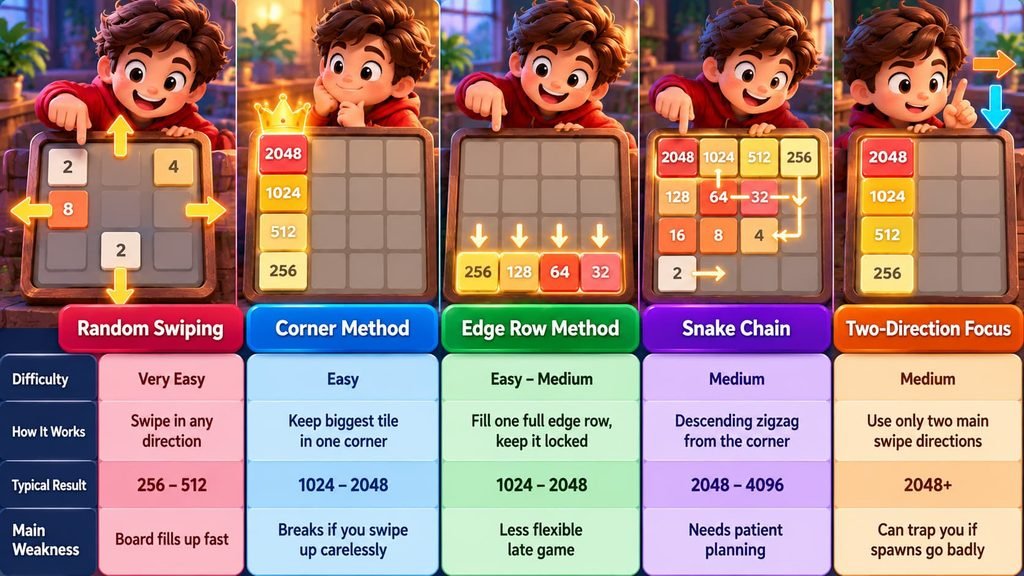
The idea is simple: pick one corner and keep your biggest tile there for the whole game. Most players use the bottom-left or bottom-right corner, but any corner works.
Why It Works
When your biggest tile sits in a corner, it’s protected on two sides by walls. Smaller tiles build up next to it, and merges flow toward it like water running downhill. A big tile stuck in the middle of the board, by contrast, blocks merges in every direction and usually ends your run.
How to Set It Up
- Choose your corner (let’s use bottom-left for this guide).
- Use mostly two directions: down and left. These push tiles toward your corner.
- Use the third direction (right) only when needed to shuffle tiles along the bottom row.
- Avoid the fourth direction (up) almost completely. Swiping up pulls your big tile out of its corner, and a new 2 can drop into the empty spot.
- Keep your bottom row full. A full row can’t shift left or right on its own, so your corner tile stays locked in place even when you press right.
Proven Strategies & Pro Tips
Build a “Snake” Chain
Once your corner is set, arrange tiles in descending order along a zigzag path. In the bottom row, values shrink from left to right (for example 512, 256, 128, 64). Then the chain turns up into the next row and runs back the other way (32, 16, 8, 4). When the smallest tile in the chain merges, it can trigger a cascade that rolls all the way back down to your corner.
Pro Tips for Everyday Play
- Think before every swipe. Ask what each direction will do to your corner tile and to the bottom row.
- Merge small tiles early. Loose 2s and 4s scattered across the board are what eventually block you in.
- Keep empty squares. Open space is your safety net. The fewer empty squares you have, the more dangerous random spawns become.
- Work in the upper rows. Do your small merging in the top half of the board, then feed the results down into your chain.
- Don’t chase every merge. A merge that pulls a tile out of position can cost you more than it gains.
- Slow down when the board gets crowded. Most game-overs come from fast, panicked swipes in the final few moves.
Common Mistakes to Avoid
- Swiping in circles (up, right, down, left) and hoping for luck.
- Letting the largest tile drift away from the corner “just once.”
- Building two equally large tiles in different areas of the board with no way to bring them together.
Comparison Table: Popular 2048 Strategies
Advanced Tactics: Building Your First 4096
Hitting 2048 is the classic goal, but most versions let you keep playing. Getting to 4096 means building a second 2048 tile next to your first one, all while the board keeps filling. Here’s how to approach it.
Lock the First 2048 Down
As soon as you reach 2048, treat that tile like a wall. It should never move from its corner again. Your entire bottom row now works as a foundation for the next build.
Rebuild the Chain From Scratch
- Start a new descending chain right next to your 2048 tile: 1024, 512, 256, and so on.
- Work the same snake pattern, but remember you now have one fewer square to work with.
- Feed small merges from the top rows down into the new chain.
- When you reach a second 1024, merge the two 1024s into a 2048 right beside the first.
- Slide them together toward your corner for your first 4096.
Recover From Bad Spawns
Sometimes a 2 lands right in your corner after a forced swipe. Don’t panic. Try to merge it immediately by building a matching tile next to it. If that fails, rebuild your chain around the second-best corner nearby rather than abandoning your structure.
Plan for Forced Moves
Late in the game, you’ll face moments where your three “safe” directions are all blocked. Before swiping up (or whatever your forbidden direction is), check which column is fullest. If your corner column is completely filled, your big tile won’t move even when you swipe up.
Use Undo Wisely (If Your Version Has It)
Some versions include an undo button. Use it to learn, not to cheat your way through every mistake. Replaying a bad move helps you see what went wrong and builds better habits for versions without it.
Final Verdict: Who Will Love This Game
2048 is one of the purest puzzle games ever made. Casual players will enjoy it as a calm, quick game to play anywhere. Puzzle and strategy fans will love finding out how much planning a simple 4×4 grid can demand. High-score chasers have a real long-term goal in 4096 and beyond.
If you remember just three things, make them these: pick a corner and stay there, build a descending snake chain, and almost never swipe away from your corner. Do that consistently, and you’ll reach 2048, and eventually 4096, far sooner than you might expect.