
By Marcus Chen • Senior Gaming Editor | Published: October 4,, 2026 | Reading time: ~5 min
Quick Summary: The Legend of Zelda: Tears of the Kingdom adds Ultrahand, Fuse, and Ascend to a revolutionary three-layer world. Featuring 152 Shrines and a massive 95-hour campaign, it earns a stellar 9.7/10.
Key Takeaways
Here is a quick summary of what you need to know before diving into the full review:
- World Design: A massive three-layer map featuring Sky islands, surface Hyrule, and the underground Depths.
- Core Mechanics: Introduction of Ultrahand, Fuse, Ascend, Autobuild, Recall, and Sage avatars.
- Puzzle Rooms: 152 bite-sized Shrines, a significant increase from the 120 in Breath of the Wild.
- Commercial Success: Sold 19.5 million copies by 2024 with a Metacritic score of 96.
- Final Score: 9.7/10 — widely considered the best Switch game of 2023.
Introduction: Returning to Hyrule
I finished Tears of the Kingdom with 145 Shrines cleared and 95 hours on my save file, and I genuinely did not want it to end. Released on May 12, 2023, as a Switch exclusive, this direct sequel to 2017’s Breath of the Wild is the most ambitious first-party Nintendo game of the generation.
The core hook revolves around three new rune abilities — Ultrahand, Fuse, and Ascend — that fundamentally change how you solve problems and interact with the environment. Furthermore, the world is now divided into three distinct layers: Sky islands above, surface Hyrule (rebuilt and expanded from BotW), and the brand-new Depths below.
TotK sold an impressive 19.5 million copies by 2024, holds a 96 on Metacritic, and was a top contender for Game of the Year in a highly stacked 2023 field.
(Note: This review is based on a launch-day Switch OLED playthrough, played almost entirely docked on a 4K TV with a Pro Controller.)
Gameplay & Combat: Building a New Meta
The Core Abilities
Three new abilities anchor the gameplay loop, completely shifting the meta:
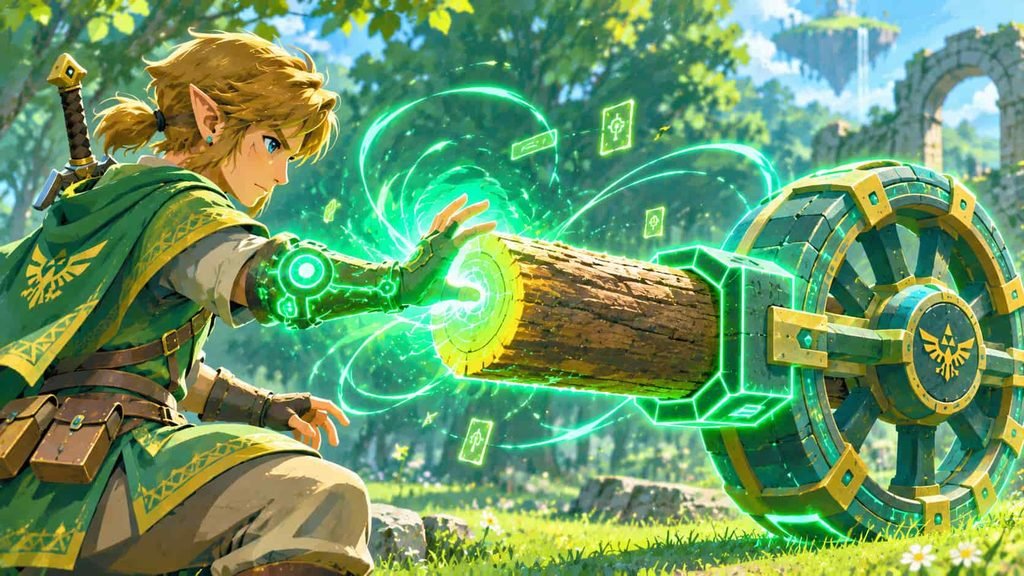
- Ultrahand: Lets you grab, rotate, and attach objects to build vehicles, bridges, and complex weapons.
- Fuse: Allows you to combine any weapon with almost any material. (e.g., A stick plus a rock equals a hammer; a sword plus a monster horn equals an elemental blade).
- Ascend: Lets you phase through any ceiling and pop out on top. It trivializes vertical navigation in a way that feels like a cheat code, but is entirely core to the level design.
- Autobuild: Recalls anything you have previously constructed for a small Zonaite cost, saving you from rebuilding complex vehicles from scratch.
- Recall: Rewinds an object’s last few seconds of motion. It is perfect for sending a falling boulder back up at its launcher.
- Sage Avatars: Replace BotW‘s champion abilities, allowing you to summon AI companions to assist you directly in combat.
Shrines, Lightroots, and Puzzles
Combat still features weapon durability, but Fuse heavily mitigates the frustration by making every broken weapon easily replaceable through crafting.
The game features 152 Shrines (up from 120 in BotW), which serve as bite-sized puzzle rooms. Brilliantly, the Lightroot count matches the Shrine count exactly — every Shrine on the surface has a corresponding Lightroot directly below it in the Depths. The puzzles are some of Nintendo’s best, and the newfound building freedom means there is usually more than one valid solution.
Story & Characters: The Zonai Mystery
Ganondorf returns, fully voiced for the first time in the franchise’s history, and he is a truly commanding villain. The story opens with the Upheaval — a cataclysm triggered when Zelda and Link investigate beneath Hyrule Castle. You wake up on Great Sky Island to find Zelda lost in time.
The Zonai civilization, an ancient race only mentioned in passing in BotW, becomes the central mystery of the campaign. Story beats are delivered through memories you find across the world, similar to the previous game, but the pacing is noticeably tighter.
The new sages — Tulin, Yunobo, Sidon, Riju, and Mineru — each receive a dedicated regional questline. The final act hits emotional notes I did not expect from a Zelda game. If you skipped BotW‘s story because it felt too optional, TotK is the direct answer to that complaint.
World & Visual Design: A Three-Layered Marvel
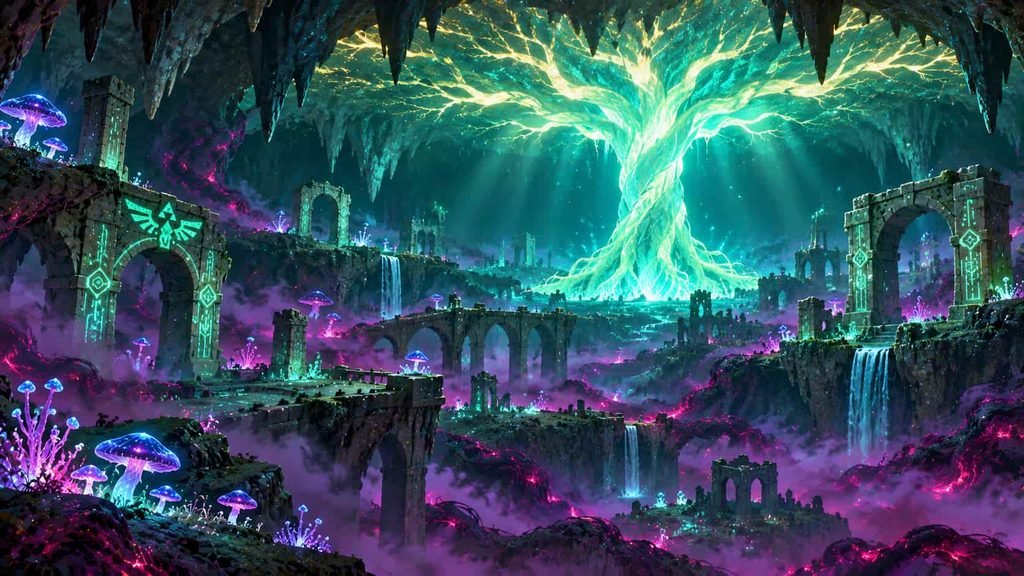
The three-layer world is the true design marvel of this title:
- Sky Islands: Offer challenging puzzle-platforming and house rare, high-tier resources.
- Surface Hyrule: Features BotW‘s familiar map but with rebuilt towns, nearly 200 new caves, and reworked enemy camps.
- The Depths: A pitch-black underworld where you navigate by Lightroots, fight Gloom-infected enemies, and mine Zonaite.
It is vertically enormous. You can stand on a Sky island, dive through a hole in the clouds, descend past the surface, and end up in the Depths in one continuous, unbroken movement. No other open world in 2023 felt this incredibly layered.
Performance & Polish: Aging Hardware, Timeless Art
On the Switch OLED, TotK targets 30 FPS and mostly hits it. However, big enemy encounters and dense areas in the Depths can dip into the low 20s. Textures are soft on a 4K TV and the Switch hardware undeniably shows its age, but the brilliant art direction carries the visual experience.
I only hit one hard crash in 95 hours of gameplay. Load times between sky-dives are remarkably snappy thanks to the game’s clever background streaming. For a 2017-era handheld running a 2023 game of this massive scope, the overall polish is nothing short of remarkable.
Pros and Cons at a Glance
The Pros
✅ Building mechanics feel genuinely magical — Ultrahand is genre-defining.
✅ Vertical world design seamlessly blends the sky, surface, and Depths into one continuous map.
✅ The Master Sword quest has a great payoff that deeply respects series lore.
✅ The soundtrack is the best in any Zelda game since Ocarina of Time.
✅ 152 Shrines with multiple valid solutions highly reward creative play.
The Cons
❌ Switch hardware shows its age with noticeable FPS dips in dense scenes.
❌ Weapon durability remains a polarizing feature, even with Fuse mitigation.
❌ The Depths feel slightly padded, featuring the same biomes across a massive underground area.
❌ Sage avatar pathing in tight spaces can sometimes be frustrating.
Final Verdict
Tears of the Kingdom earns a well-deserved 9.7/10. It is the best Switch game of 2023 and a worthy sequel that expands Breath of the Wild in every conceivable direction. The building mechanics alone would carry a lesser game. While the aging Switch hardware holds it back slightly, Nintendo’s masterful art direction and level design mask most of the technical limitations. It is a genre high point and an easy, enthusiastic recommendation for any Switch owner.
Frequently Asked Questions
Is Tears of the Kingdom worth playing without playing Breath of the Wild?
Yes. The story recaps what you need to know, and the mechanics are much friendlier to newcomers. You will miss some deep lore references, but TotK works perfectly as a standalone entry. Returning BotW players will recognize the map but will find more than enough new content to justify the trip back.
How long is Tears of the Kingdom?
A main-path run takes about 50-60 hours. With Shrines, side quests, and Depths exploration, expect 90-130 hours. Completionist runs that clear every Shrine, Lightroot, and side quest can easily hit 200+ hours.
How many Shrines are in Tears of the Kingdom?
There are 152 Shrines on the surface, up from 120 in BotW. The Depths contain 120 Lightroots, each placed directly beneath a corresponding surface Shrine, which makes navigating the dark underworld surprisingly intuitive.
Can you play Tears of the Kingdom on Switch Lite?
Yes. It is the exact same game. The building mechanics work fine with the smaller Joy-Con sticks. While docked play on a 4K TV highlights the hardware’s limits, it is fully playable and highly enjoyable on the Lite and undocked OLED.
Is Tears of the Kingdom better than Breath of the Wild?
For most players, yes. The building mechanics add a massive creative layer, the story is tighter, and the world is significantly denser. However, some purists prefer BotW‘s leaner, more focused approach to pure discovery. Either way, both are essential Switch titles.
Sources & References
- Nintendo.com — The Legend of Zelda: Tears of the Kingdom official site
- Metacritic — Tears of the Kingdom (Score: 96)
- Nintendo Investor Relations — Tears of the Kingdom sales report (2024)
- IGN — Tears of the Kingdom review (Accessed: November 3, 2026)