
By Alex Reed, Senior Gaming Contributor
There’s a special kind of panic that only endless runners deliver. You’re three minutes into your best run ever, the coin counter is spinning, the music has picked up tempo, and then a barrier you definitely should have seen sends your character face-first into the pavement. Game over. Tap to retry.
And you will tap to retry. That’s the magic of the genre. From Temple Run and Subway Surfers to browser favorites like the Chrome Dino game, endless runners have survived more than a decade of trends because they’re instantly understandable, playable in short bursts, and brutally honest. There’s no story to skip and no grinding required. It’s just you, your reflexes, and a track that never ends.
The good news is that the players at the top of the leaderboards aren’t just born with faster thumbs. They’ve learned to see danger earlier and move at the right moment, and both of those are skills you can train. This guide breaks down how.
Core Mechanics: How Endless Runners Work
The Gameplay Loop
Nearly every endless runner follows the same simple loop:
- Your character moves forward automatically.
- Obstacles appear in your path.
- You dodge them with a small set of moves.
- You collect coins or pickups along the way.
- The game gradually speeds up until you make a mistake.
That last point is the whole game. Endless runners aren’t designed to be beaten; they’re designed to slowly outpace you. Your score is really a measure of how long you can keep up with the rising speed.
Controls and Movement Types
Most runners use one of three control styles:
- Lane-based (e.g., Subway Surfers): Swipe left or right to change between three fixed lanes, swipe up to jump, swipe down to slide.
- Single-button (e.g., the Chrome Dino game, Geometry Dash-style games): One tap to jump, sometimes held for a higher jump.
- Free-movement: Tilt or drag to steer smoothly across the track.
The Rules of the Track
Obstacles usually fall into three families: things you jump over (low barriers, gaps), things you slide under (overhead bars, signs), and things you steer around (trains, walls, blocked lanes). Learning to identify which family an obstacle belongs to at a glance is the foundation of everything else in this guide.
Proven Strategies & Pro Tips
Look Further Ahead Than Feels Natural
The single most common mistake new players make is staring at their own character. Your character is the one thing on screen you don’t need to watch. You already know where it is.
- Shift your eyes to the upper third of the screen. That’s where new obstacles appear, and spotting them early buys you precious time.
- Use your peripheral vision for your character. You’ll still notice its position without looking directly at it.
- Read obstacles in groups, not one at a time. Instead of reacting to “barrier,” start thinking “barrier, then train on the left, then coin trail on the right.” You’re planning a route, not just surviving the next second.
Make Your Decision Early, Execute It On Time
There’s a difference between deciding and acting. Top players decide what move they’ll make as soon as an obstacle appears, then wait for the right moment to perform it.
- Decide immediately which move the obstacle needs.
- Wait until it’s at a consistent distance from your character.
- Act at that same spot every time.
That consistent “trigger spot” is your secret weapon. Pick a visual landmark (say, when the obstacle reaches the length of two characters away) and train yourself to move there. Consistency beats raw speed.
Avoid These Common Mistakes
- Panic swiping. Mashing inputs often queues up moves you didn’t mean to make, especially in lane-based games.
- Chasing every coin. A coin trail that leads into a tight spot isn’t worth your run.
- Jumping too early. In many runners, landing early leaves you exposed to the next obstacle. Timing matters on both ends of a jump.
- Playing tired. Reaction time drops noticeably when you’re fatigued. If you’ve died three times in a row to easy obstacles, take a break.
Comparing Common Survival Approaches
Not every playstyle suits every player. Here’s how the main approaches stack up:
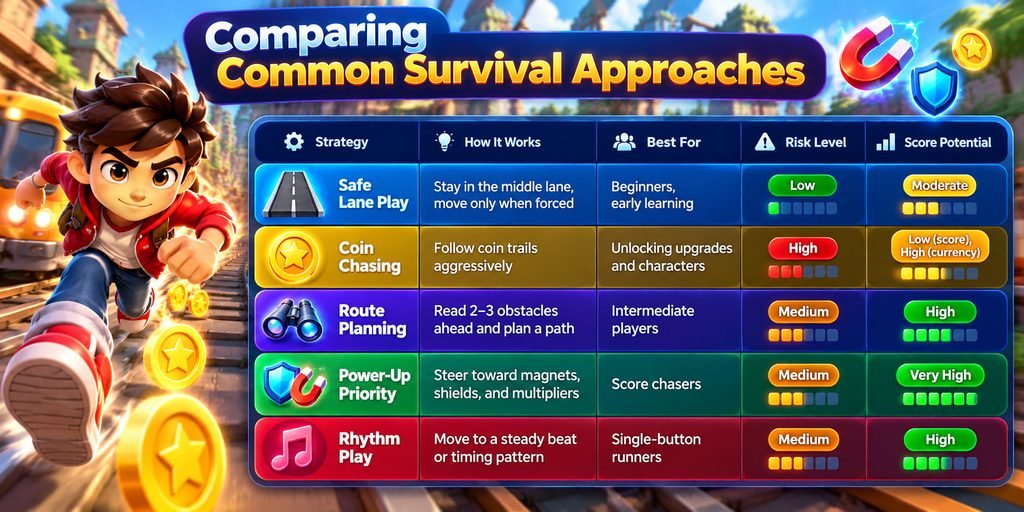
Most strong players blend Route Planning with Power-Up Priority. Start with Safe Lane Play while you’re learning, though. It’s the fastest way to build instincts.
Advanced Tactics & High-Score Secrets
Use the Middle Lane as Home Base
In three-lane games, the middle lane gives you two escape options instead of one. Whenever you have a breather, drift back to center. Being stuck on an outer lane when a wall appears is how good runs end.
Learn the Patterns
Endless runners aren’t as random as they look. Most games build their tracks from pre-designed chunks that repeat in different orders. After enough runs, you’ll start recognizing these sections (“oh, this is the one with the double train”). Once you know a chunk, you can run it on autopilot and save your attention for the unfamiliar stuff.
Time Your Power-Ups
Don’t burn a shield or score multiplier in the slow, easy opening. Save activatable boosts for when the speed climbs. A multiplier is worth far more points when you’re moving fast, and a shield is far more valuable when mistakes are more likely.
Adjust Your Trigger Spot as Speed Increases
Here’s the secret most players never figure out: as the game gets faster, your trigger spot needs to move further away from your character. The same reaction delay covers more ground at higher speeds. If you start clipping obstacles late in a run, you’re not getting slower. Your timing just needs to move up a beat.
Play With Sound On
Many runners use audio cues for incoming hazards, and the music often speeds up with the game. Sound gives you a second warning channel that doesn’t compete with your eyes.
Check Your Setup
On mobile, turn off battery saver modes that can cap frame rates. In browser games, close extra tabs. A small delay between your tap and the action on screen can make perfectly timed inputs feel wrong, and it’s frustrating to blame yourself for lag that isn’t your fault.
Practice in Short, Focused Sessions
Ten minutes of attentive play beats an hour of zoning out. Try giving each session a goal: “This time I’m only watching the top of the screen,” or “This time I’m not chasing a single coin.” Small, focused drills build habits fast.
Final Verdict: Who Will Love This Game?
Endless runners are perfect for players who want quick, satisfying sessions that fit into a coffee break or a commute. They’re ideal for competitive types who love chasing friends’ high scores, and they’re surprisingly great for anyone wanting to sharpen their reflexes and focus. Every run makes you a little bit better.
If you prefer deep stories or slow, thoughtful strategy, the genre’s relentless pace might wear on you. But if the idea of “just one more run” sounds exciting rather than exhausting, you’re in the right place.
Remember the core lessons: look ahead, decide early, act on time, and adjust as the speed climbs. Master those four habits, and you’ll stop asking “where did that come from?” and start asking “how high can this score go?”
Now get back out there. The track isn’t going to run itself.