
By Sarah Mitchell • Indie Games Writer
Published: October 23, 2026 | Reading time: ~5 min
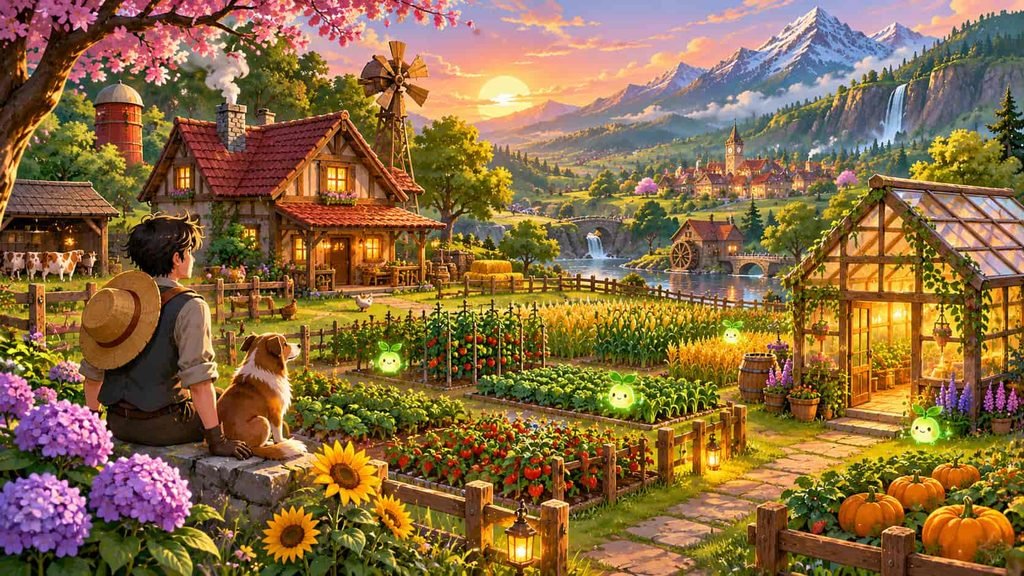
Quick Summary: Stardew Valley review: 800+ hours in, ConcernedApe’s pixel farming sim still earns its 30M sales. Featuring 12 spouses, 4 seasons, 120 mine floors, and the free 1.6 update. Final Score: 9.5/10.
Key Takeaways
Here is a quick summary before you dive into the full review:
- Length: A 100-percent save runs 80-120 hours across multiple farms and spouses.
- Updates: The free 1.6 update (March 2024) added festivals, new mine layouts, and the Mystic questline.
- Cast: Features 12 marriage candidates, each with a fully realized character arc.
- Platforms: Available on PC, Mac, Linux, all modern consoles, iOS, Android, and PS Vita.
- Score: 9.5/10 — Arguably the most important farming sim ever made.
Introduction: A Decade of Pixel Perfection
I have an 827-hour save file in Stardew Valley spread across four farms: a Forest Farm that taught me how to play, a Four Corners map I share with three co-op buddies, a Beach Farm I started after the 1.6 update, and a Wilderness Farm I keep around purely for late-night monster hunting. Eric Barone’s pixel farming sim came out on February 26, 2016, sold 30 million copies by 2024, and somehow still gets free updates. ConcernedApe is the rare solo developer who has earned the right to stop, yet he keeps going anyway.
I have done everything in Stardew Valley. Every bundle in the Community Center, every JojaMart membership route, and every marriage candidate. I’ve cleared every floor of the 120-floor Mines and dug as deep as my patience allowed in Skull Cavern. The 1.6 update added the Mystic questline, new festivals, and fresh NPC dialogue that made me start a fifth save just to see what had changed.
This is a cozy classic that refuses to die. I’m going to tell you why, almost a decade after launch, it still earns its place on my SSD—and where it shows its age.
Gameplay & Crop Life: Layering the Systems
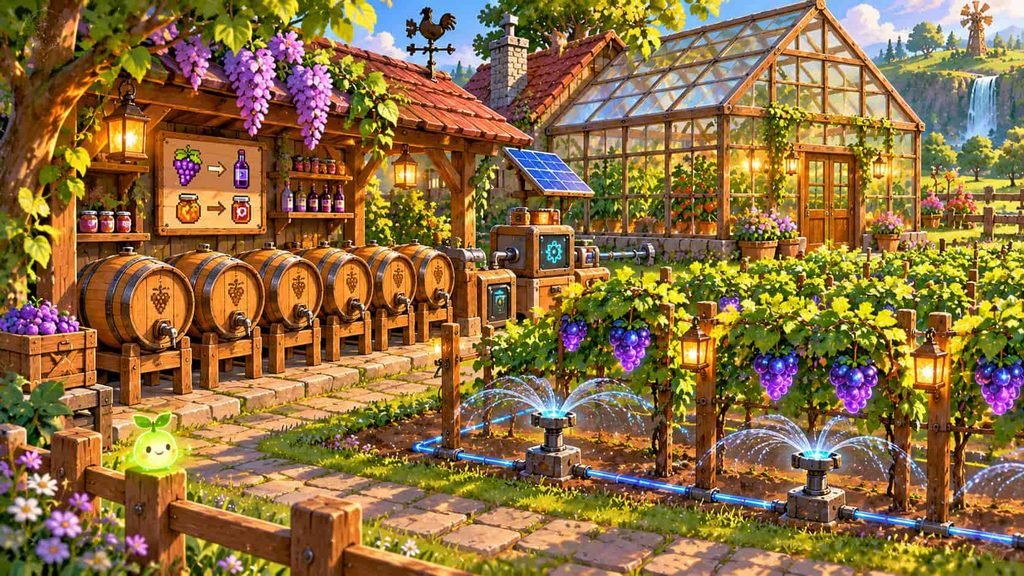
Stardew Valley is built on a four-season calendar, with each season lasting 28 days. Crops only grow in their assigned window. Plant Parsnips on Spring 1, and you have four days until harvest. Plant Melons, and you wait twelve. Get the timing wrong, and you lose a season.
It sounds simple until you start layering systems:
- Sprinklers to automate watering.
- Kegs to ferment fruit into wine worth triple the raw price.
- Preserves jars to pickle vegetables.
- The Greenhouse, which lets you grow any crop year-round.
The first time I built a fully-irrigated Ancient Fruit wine farm, I felt like an industrial engineer.
The Community Center route is the heart of the early game. You collect bundles to repair the dilapidated community building, with the Junimos acting as your forest spirit helpers. JojaMart is the alternate “easy” path where you pay cash to skip bundles, at the cost of a more corporate, soulless Pelican Town. I always prefer the Community Center because the Junimos feel like real characters.
Mining and combat serve as the secondary gameplay loops. The Mines feature 120 floors split into themed zones (dirt, ice, lava) with boss floors at 20, 60, and 120. Skull Cavern in the Calico Desert has no floor cap; you dig until you die, hoping for a staircase spawn or a Prismatic Shard. Combat is light, but the deeper systems reward careful preparation.
Story & Townsfolk: The Heart of Pelican Town
You inherit the Pelican Town farm from your recently-deceased grandfather, who left a letter telling you to come when the corporate grind became too much. That setup—escaping a soulless Joja Corporation job to work the land—is the entire emotional scaffolding. The story is not epic; it is the slow accumulation of small relationships. Every villager has a daily schedule, two heart events triggered by friendship levels, and a marriage arc.
The twelve marriage candidates each have a real, evolving arc:
- Shane: His depression arc is written with a care that genuinely surprised me, standing as one of the best depictions of mental illness in a cozy game.
- Penny: Showcases her deep care for the kids in the trailer park.
- Sebastian: Explores his isolation in his basement room.
- Abigail: Highlights her rebellion against her father, Pierre.
- Elliott: Focuses on his grand literary ambitions.
These are not throwaway NPCs. The 1.6 update added new dialogue across the whole cast, finally giving characters like Lewis, Marnie, and Demetrius more to do than just stand around.
World & Visual Design: Evocative Pixel Art
Stardew Valley is pixel art at its most evocative. Every season has its own distinct palette—spring greens, summer gold, autumn orange, and winter blue. The music loops are earworms I still hum months later.
Locations like Pelican Town, the Forest, the Beach, the Mountains, the Desert, and Ginger Island all feel distinct without losing the cozy baseline. The 1.6 update added new festivals like the Trout Derby and the Desert Festival, giving the world a fresh seasonal rhythm. Remarkably, the 2D tileset holds up at any modern resolution; it is one of the few pixel art games that looks perfectly right on a 4K monitor.
Performance & Polish: Running on Anything
Stardew Valley runs on literally anything. The game is officially supported on:
- PC (Steam and GOG), Mac, and Linux
- PS4, PS5, and PS Vita
- Xbox One and Xbox Series
- Nintendo Switch
- iOS and Android
Multiplayer co-op arrived in 2018 and supports up to 4 players on PC (up to 8 with mods). On a Steam Deck, my battery lasts over 6 hours. Mod support is best on PC, where SMAPI and a decade of Nexus Mods have kept the game alive long after ConcernedApe stopped needing to.
The only weak spot is the mobile port, which lagged the 1.6 update by months and still lacks some of its features as of late 2026.
Pros and Cons at a Glance
The Pros
- Endless Replayability: Across multiple farm types, marriage candidates, and bundle paths.
- Timeless Aesthetics: Charming pixel art and a soundtrack that have aged perfectly.
- Robust Multiplayer: Co-op for up to 4 players natively, 8 with mods.
- Incredible Mod Support: Has kept the game alive and evolving for a decade.
- Generous Updates: The free 1.6 update added festivals, mine layouts, and the Mystic questline.
- Universal Accessibility: Runs smoothly on any hardware, from a PS Vita to a high-end PC.
- Deep Characters: All 12 marriage candidates have real, meaningful character arcs.
The Cons
- Lack of True Endgame: No structured endgame content beyond Year 3 other than self-imposed goals.
- Underused Mechanics: The Junimos feel underutilized outside the Community Center bundles.
- Tedious Grinding: Endgame mineral grinding (iridium, radioactive ore) can become a chore.
- Mobile Lag: The mobile port lags behind PC/console updates and lacks some 1.6 features.
- No Cross-Save: No native cross-save functionality between different platforms.
Verdict: The Most Important Farming Sim
Stardew Valley is the most important indie game of the 2010s and arguably the most important farming sim ever made. ConcernedApe shipped a 30-million-copy game solo, then spent a decade polishing it for free. The 1.6 update is the work of someone who still cares, eight years after launch.
If you have ever wanted to escape into a pixel town where your neighbors remember your birthday, this is the game. The underused Junimos and the tedium of late-game grinding cost it half a point, but only half.
Final Score: 9.5/10
Frequently Asked Questions
Is Stardew Valley worth it in 2026?
Yes. The 1.6 update in March 2024 added new festivals, mine layouts, the Mystic questline, and fresh NPC dialogue. With massive mod support on PC and ongoing community patches, it is the best time to start a save even now.
How long is Stardew Valley?
A standard Community Center completion run takes 20-30 in-game hours (about 30-40 real hours). A 100-percent save with all marriage candidates, all 120 mine floors, and all Golden Walnut collectibles on Ginger Island will take 80-120 hours.
Can you play Stardew Valley multiplayer?
Yes. Multiplayer co-op was added in 2018 and supports up to 4 players natively on PC, Mac, PS4/PS5, Xbox, and Switch. Mods can extend that to 8 players on PC. The host owns the farm, while other players join as farmhands.
What platforms is Stardew Valley on?
It is available on PC (Steam and GOG), Mac, Linux, PS4, PS5, Xbox One, Xbox Series, Nintendo Switch, iOS, Android, and PS Vita. Note that cross-save between platforms is not natively supported.
Should I pick the Community Center or JojaMart?
Choose the Community Center your first time. The bundle collection teaches every system in the game and rewards you with the charming Junimo cinematics. On a second run, JojaMart is faster and lets you buy everything directly, which is useful for cash-heavy playthroughs.
References & Further Reading
- Steam: Stardew Valley Store Page
- ConcernedApe: Developer Blog and 1.6 Update Notes
- Stardew Valley Wiki: Official Community Wiki
- Reddit: r/StardewValley Community Subreddit
